 Skip to content
How Long Does an EBOO Therapy Session Last?
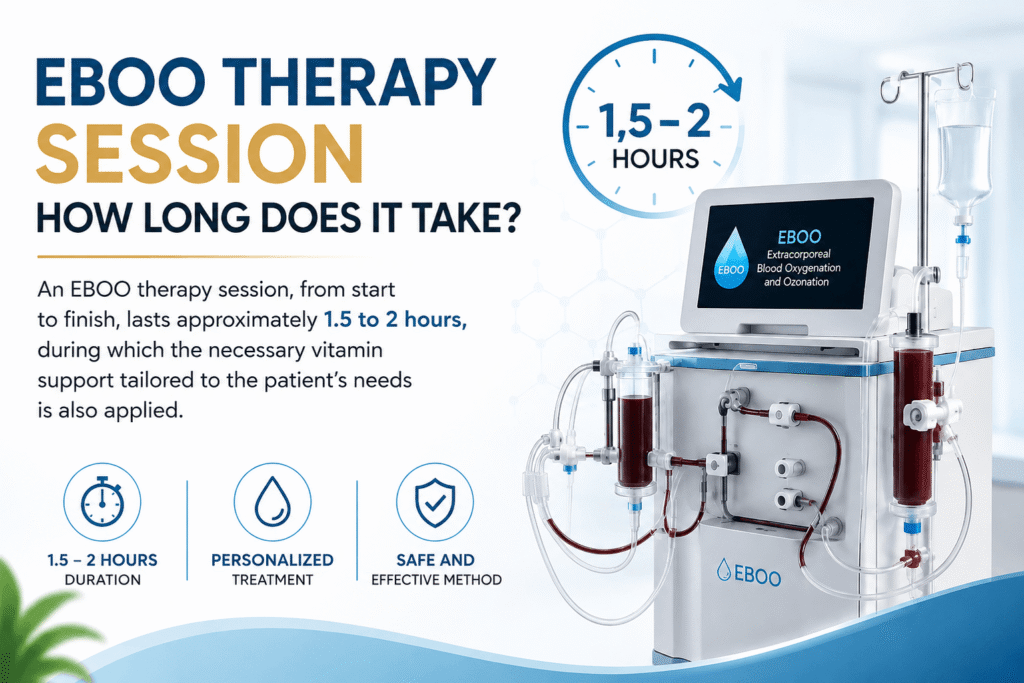
How long does an EBOO therapy session last? This is one of the most common questions patients ask before scheduling their first appointment. In general, an EBOO therapy session takes approximately 1.5 to 2 hours from the beginning of the procedure until completion. The exact duration may vary slightly depending on the patient’s individual needs, health status, and the protocol planned by the physician.
EBOO is not a procedure that is completed within just a few minutes. Several stages take place during the session, and the process is carried out in a controlled clinical environment. Patients are monitored by healthcare professionals throughout the procedure, with attention given to both safety and comfort.
1. Why Does an EBOO Session Take 1.5 to 2 Hours?
During EBOO therapy, blood circulates through a specialized system outside the body. Depending on the protocol being used, the process may include filtration, oxygenation, and controlled medical ozone application before the blood returns to the circulation.
These stages require time because the process needs to proceed at an appropriate and controlled rate. The goal is not to complete the session as quickly as possible, but to follow the protocol prepared for the individual patient.
For this reason, one patient’s session may be completed closer to 1.5 hours, while another appointment may take approximately 2 hours.
2. What Happens Before the EBOO Session?
The actual procedure is only one part of the appointment. Before starting, the healthcare team may complete several preparation steps.
For a first appointment, the physician may review the patient’s medical history, current health status, medications, previous procedures, and other relevant information. Existing laboratory results may also be reviewed when necessary.
The procedure can then be explained to the patient, and any questions can be discussed before starting. This preparation may increase the total amount of time spent at the clinic, particularly during the first visit.
3. Can IV Vitamin Support Be Given During EBOO?
Depending on the patient’s individual plan, the physician may determine that intravenous vitamin or nutritional support is appropriate.
When medically indicated, these supportive applications may be planned during the same appointment. Since an IV infusion can sometimes be administered while the EBOO process is taking place, it may not necessarily add significant time to the overall session.
However, IV vitamin support should not be considered a standard requirement for every patient. Whether an additional infusion is appropriate should be determined individually by the physician.
4. Is the Session Length the Same for Everyone?
No. Although 1.5 to 2 hours is a useful general estimate, the exact duration of an EBOO therapy session can vary between patients.
Individual health needs, the planned protocol, preparation time, vascular access, additional physician-approved applications, and the patient’s condition during the session can all influence the total duration.
This is why another patient’s appointment length should not be used to predict exactly how long your own session will take.
5. What Does the Patient Do During the Session?
During the procedure, patients can usually remain in a comfortable seated or reclining position while the EBOO system operates.
The medical team monitors the procedure and observes the patient’s general condition throughout the session. If the patient experiences discomfort or feels different at any point, they should inform the healthcare professionals supervising the procedure.
Because EBOO involves vascular access and blood circulation through an external system, appropriate clinical conditions and professional monitoring are important parts of the process.
6. What Happens After the Session?
Once the procedure is completed, the healthcare team may check how the patient is feeling before they leave the clinic.
Some patients may prefer to rest briefly following the session. The physician or medical team may also provide individualized recommendations regarding hydration, physical activity, nutrition, or the rest of the day.
Patients should follow the instructions given by their healthcare professionals rather than assuming that another person’s post-session routine will also be appropriate for them.
When planning your appointment, it can therefore be helpful to leave some additional time after the expected procedure rather than arranging another commitment immediately afterward.
7. How Much Time Should You Plan for Your Appointment?
If you are wondering how long does an EBOO therapy session last, planning approximately 1.5 to 2 hours for the procedure itself is a practical starting point.
For your first visit, however, it may be sensible to allow additional time. Medical evaluation, preparation, questions before the procedure, and a short period of observation afterward can make the total clinic visit longer than the actual EBOO session.
Your healthcare team can provide a more accurate estimate once your individual protocol has been determined.
Ultimately, the duration should not be the only consideration when planning EBOO therapy. Appropriate medical evaluation, professional supervision, clinical standards, and an individualized protocol are more important than completing the procedure quickly.
For this reason, patients should discuss both the expected session duration and their individual plan with the physician before the appointment. This provides a clearer idea of what to expect and how much time to reserve for the entire visit.
What Is the Difference Between EBOO Therapy and Ozone Therapy?
One of the most common questions patients ask is how EBOO therapy differs from conventional ozone therapy. Although both treatments are based on the therapeutic use of medical ozone and share several similar principles, EBOO therapy combines multiple advanced technologies into a single procedure, making it a more comprehensive treatment approach.
Conventional ozone therapy primarily focuses on delivering medical ozone to support the body’s natural physiological processes. EBOO therapy, on the other hand, incorporates the principles of multipass ozone therapy while simultaneously circulating the blood through a specialized extracorporeal system. During the procedure, the blood is continuously exposed to medical ozone and oxygen while passing through a filtration system designed to help remove certain toxins from the bloodstream.
Another important feature that distinguishes EBOO therapy is the integration of ultraviolet (UV) blood irradiation. As the blood circulates through the treatment system, it is exposed to ultraviolet light, which may contribute to the breakdown of circulating antigen-antibody complexes as part of the overall therapeutic process. By combining several treatment modalities within one session, EBOO therapy offers a broader therapeutic protocol than conventional ozone therapy alone.
Because EBOO therapy brings together ozonation, oxygenation, blood filtration, and ultraviolet blood irradiation in a single continuous circulation system, it is widely regarded as a more advanced and comprehensive form of ozone-based therapy. Rather than relying on a single therapeutic mechanism, the procedure integrates multiple complementary processes designed to work together throughout the treatment session.
The choice between conventional ozone therapy and EBOO therapy ultimately depends on the patient’s individual medical condition, treatment goals, and the physician’s clinical assessment. Following a comprehensive evaluation, the physician can determine the most appropriate treatment protocol and whether EBOO therapy is the most suitable option based on the patient’s specific healthcare needs.
